Most people learn astrology backwards. They memorize what the Sun in each sign means, then open a chart looking for confirmation of a description they read somewhere else. A chart is a structure with a load-bearing order, and reading it out of order is the most common reason an interpretation sounds like a newspaper column instead of a reading.
Why the order matters more than the vocabulary
Sun-sign astrology is written to be broadly true, so it can afford to be vague. A chart reading has to be specifically true or it is doing nothing, and the difference is not how much symbolism you know. It is the order in which you apply it.
Read the overall posture first, then the major bodies, then the relations between them. Start with one planet and its sign and you have described one twelfth of the population. Start with the frame and every detail has somewhere to sit.
Step one: the Ascendant and the shape of the chart
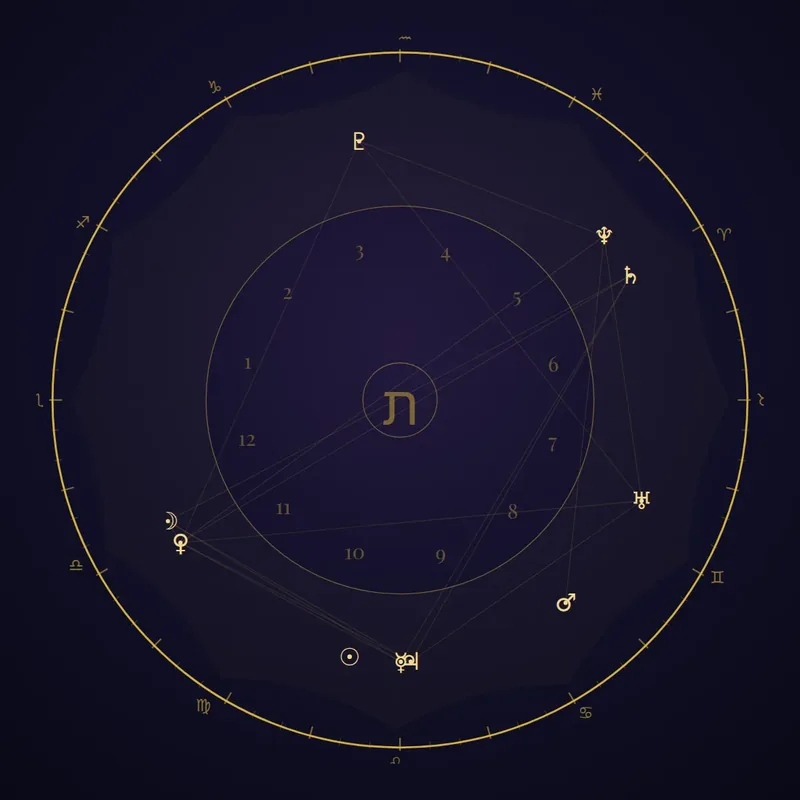
The Ascendant is the degree of the zodiac rising on the eastern horizon at the moment of birth. It sets the whole house frame, so it is read before anything inside the frame. The Earth turns at roughly one degree of Ascendant per four minutes, so a birth time rounded to the nearest quarter hour can move the Ascendant several degrees, and sometimes move a house cusp past a planet.
Positions come from ephemerides, tables of where the bodies actually were. Houses come from the time and the latitude, which is why two people born the same day in different cities do not share a chart.
Then look at the shape: how the planets are distributed around the wheel. A chart with everything above the horizon reads differently from one clustered in a single quadrant, and an empty hemisphere is information, not absence.
Step two: the Sun and the Moon
Only now do the luminaries come in. The Sun describes what a person is oriented toward, the activity that feels like their own life rather than a role. The Moon describes how they process experience, what they do with a feeling before they have language for it. Read them as a pair, against the Ascendant.
When all three agree, the person presents as one consistent thing. When they disagree, the disagreement is the reading. A Leo Sun with a Cancer Moon and a Scorpio Ascendant is not three descriptions but one person whose public manner, private processing and sense of purpose pull apart, and the chart has to say how that is managed.
Step three: the personal planets
Mercury, Venus and Mars handle the traffic of ordinary life: how someone thinks and argues, what they value and how they attach, how they pursue and defend. Because these three move quickly, their house positions are especially sensitive to the birth time.
Read each by sign, then by house, then by the condition of its ruler. A planet in its own sign behaves differently from the same planet in a sign it has no stake in, and the difference shows in how easily the person uses that function.
Step four: aspects and orbs
An aspect is an angular relationship between two positions. The five major aspects have fixed angles, and each is allowed a tolerance, an orb, within which it still counts.
| Aspect | Exact angle | What it describes |
|---|---|---|
| Conjunction | 0 degrees | Two functions fused, hard to separate |
| Sextile | 60 degrees | Ease that needs an occasion to be used |
| Square | 90 degrees | Friction that forces adjustment |
| Trine | 120 degrees | Flow that can go unnoticed |
| Opposition | 180 degrees | A tension held between two poles |
Use eight degrees for aspects involving the Sun or Moon, six between the personal planets, and three to four when Saturn, Uranus, Neptune or Pluto touch a personal point. The wider allowance for the luminaries reflects how much of the chart they carry, not sentiment; an outer planet is held tighter because a slow body makes a weak claim on a personal one.
Step five: house overlays
Signs describe quality; houses describe where a thing happens. A planet is not read until it has both. The same Mars in the same sign reads differently in the seventh house, where it enters partnerships, and in the tenth, where it enters public work.
Place the outer planets last, and lightly. Saturn through Pluto move slowly enough that whole cohorts share a sign, so they describe conditions rather than traits. Read them where they touch a personal point, and otherwise treat them as background.
A worked example: 87 degrees
Two hypothetical positions, clearly labelled as an example: a planet at 12 degrees of Taurus and another at 9 degrees of Leo. Three signs on from Taurus is 90 degrees, which lands at 12 degrees of Leo; the second planet sits 3 degrees before that point, so the separation is 87 degrees.
The nearest exact aspect is the square at 90 degrees. The orb is the difference, 90 minus 87, which is 3 degrees. That falls inside the six degree allowance for two personal planets, so the square is read at moderate weight.
| Separation | Nearest aspect | Orb | How it reads |
|---|---|---|---|
| 89.5 degrees | Square | 0.5 degrees | A daily, identifiable pattern |
| 87 degrees | Square | 3 degrees | Present, requires attention to notice |
| 83 degrees | Square | 7 degrees | Outside the personal allowance, a trace at most |
This is why the number matters as much as the geometry. At half a degree the person usually recognizes the friction at once and can name where it appears: in how they speak, in what they keep agreeing to. At seven degrees between two personal planets the aspect exceeds the stated tolerance and should be dropped or called faint background pressure. A reading that treats all three cases alike has stopped measuring.
What this cannot tell you
- It cannot correct a birth time you do not have. Rectification is an inference, and every house placement inherits its uncertainty.
- It cannot predict events. A chart describes conditions, not a dated outcome, and a reading that offers one has left the method.
- It cannot describe your health, money or family in material terms, and it does not replace care from a doctor or a therapist.
- It cannot settle its own disputes. Two competent practitioners may weigh the same factors differently, and the chart does not arbitrate.
Common questions
Do I need an exact birth time?
For the Ascendant and the houses, yes, or close to it. The slower planets will be nearly right without a time, but the frame that organizes them will not. If you only know the hour, the reading should say what the uncertainty affects. A sample reading shows how much the frame changes.
Why does my Sun sign description not match me?
Because the Sun is one factor among several, and often not the dominant one. The Ascendant governs how you come across, the Moon governs how you process, and either can outweigh the Sun. A description written for one twelfth of the population is not a description of you.
What orb is too wide?
Wider than the allowance for the bodies involved: eight degrees for the Sun or Moon, six for the personal planets, three to four when an outer planet touches a personal point. Beyond that, the aspect is a coincidence of geometry rather than a relationship worth building on.
Can I read a chart without houses?
You can read signs and aspects, and many people start there. What you lose is location: the chart stops saying where a pattern operates. The glossary covers the houses if you want that layer without learning the whole vocabulary at once.
Reading in this order is slower than reciting meanings, and it produces a reading that can be checked against the person in front of you. The sequence is the method; the vocabulary is only material. To see the whole structure assembled from a real birth time, the natal chart reading is where that happens.
Get your personalized natal chart reading
Receive your personalized PDF within 24 hours.