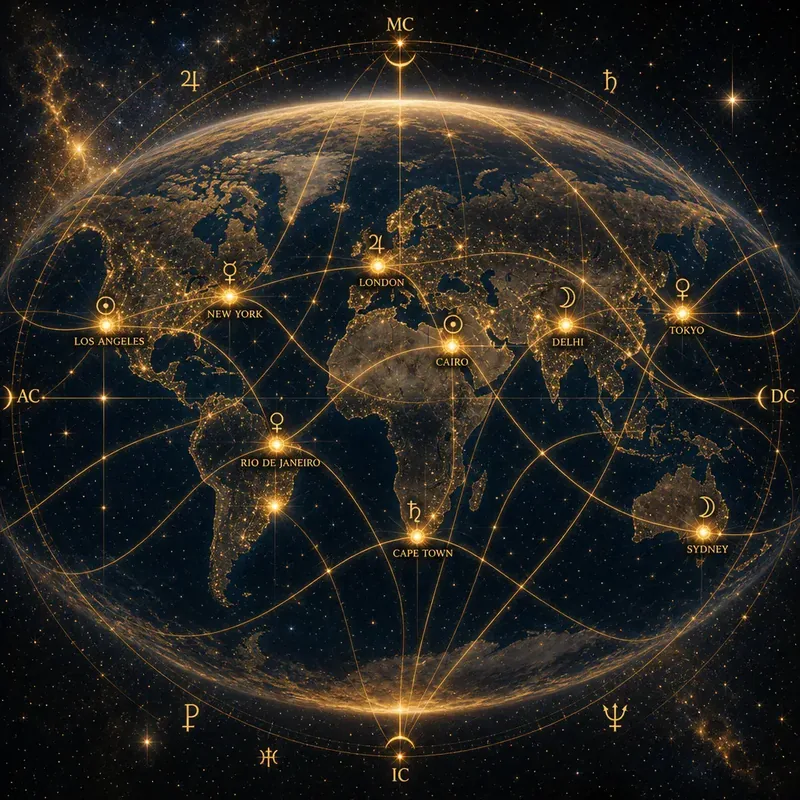
Astrocartography is usually sold as a map of lucky cities, with lines running through the places where your life is supposed to go well. That is not what the technique produces. It produces a projection: the four angles of one birth chart, drawn onto the surface of the Earth for the exact moment of birth. Everything the map can say follows from that geometry, and most of what it is asked to say does not.
Four angles, ten bodies, forty lines
A natal chart is built around four angles: the Midheaven, the Imum Coeli, the Ascendant and the Descendant. Each describes where a point of the zodiac sat relative to the local sky at birth. Astrocartography asks a different question of the same geometry: at which places on Earth was this planet on one of those four angles at that moment.
| Angle | Where the planet was | Line on the map |
|---|---|---|
| Midheaven (MC) | Crossing the local meridian, at its highest | Meridian line, roughly north to south |
| Imum Coeli (IC) | On the opposite meridian, at its lowest | Opposite meridian, roughly north to south |
| Ascendant (ASC) | Rising on the eastern horizon | Curved line, west of the meridian pair |
| Descendant (DSC) | Setting on the western horizon | Curved line, east of the meridian pair |
Four lines per planet. A chart with ten bodies yields about forty lines, which is why a finished map looks crowded and why the first task is not interpretation but selection.
Why the lines run the way they do
The meridian lines are lines of longitude, because "on the meridian" means the local sidereal time at that place matched the planet's right ascension. That condition depends on longitude, not latitude, so the MC and IC lines run roughly north to south, and the two of them sit half a world apart.
Horizon lines are different. Whether a planet is rising depends on both longitude and latitude, since the horizon is a tilted circle relative to the Earth's axis. The ASC and DSC lines therefore curve, and on a world map they can sit thousands of kilometres away from the meridian lines. A city can be close to one of a planet's lines and far from the other three.
Fixed at birth, which is the point
The lines do not move during your life. They are a property of one instant: the sky as it stood over one place at one time. Nothing you do changes where a planet's MC line fell at your birth, and no line becomes more available as you get older.
What changes is you, and where you stand. The map is static; the reading is not. This is also why astrocartography is not the same as a relocated chart. A relocated chart recomputes the houses for a new place and answers what your chart looks like from there. Astrocartography keeps the original chart and shows where its angles fell. They are related computations, not the same one.
What "on the line" actually measures
Standing exactly on a planet's MC line means that, at the moment you were born, that planet was on the local meridian of that place. Move a few hundred kilometres east or west and the local meridian at your new longitude no longer holds it. You are not on the line; you are near it.
So proximity needs a distance, and the distance is something the reader chooses. A working convention is to treat a place as connected to a line when it falls within about 150 to 300 km of it. That range is a convention for making the map usable, not a rule the sky enforces, and a stricter or looser band will change which cities qualify.
The arithmetic is simple enough to check. The Earth's circumference is about 40,000 km, so one degree of longitude is roughly 111 km at the equator, a figure that shrinks with the cosine of the latitude. At 40 degrees north it is about 85 km. A 150 km band is therefore close to 1.8 degrees of longitude there, and a 300 km band close to 3.5 degrees. On a map of the world, that is a thin strip; the line drawn on a poster is thinner still.
The determinism problem
A line describes a condition of the sky. It does not describe an outcome, and it cannot tell you that a city will suit you. The common reading, in which a Jupiter line means luck and a Saturn line means hardship, converts a geometric fact into a promise, and the promise is not in the data.
Two corrections follow. First, a line does not override the natal chart it came from. A difficult configuration is still difficult on a Jupiter line; the line changes which angle of the chart is emphasised at that place, not the chart itself. Second, the material conditions of a move (work, visa, language, money, family) are not represented on the map at all, and no line compensates for their absence.
What remains is more modest and more useful: the map tells you which part of your chart is angular in a given place. That is a real piece of information about emphasis, and it is worth having, as long as it is not asked to be a verdict.
What this cannot tell you
- It cannot promise an outcome. No line causes an event, and none can be read as advice to move.
- It cannot draw a sharp boundary. Proximity is continuous, and "on the line" is a distance you define, not a property of the place.
- It cannot survive a bad birth time. The Ascendant moves about one degree every four minutes, so the ASC and DSC lines shift substantially when the time is rounded.
- It cannot weigh how long you stay, what you do there, or the rest of the chart, and it does not replace medical, legal or financial advice.
Common questions
Do I have to move to use this?
No. Most of the value is in seeing which angles of your natal chart are emphasised where, including the place you already live. A reading of the map is a reading of emphasis, and emphasis is legible without booking a flight.
Why are there so many lines?
Because every planet produces four. Ten bodies give about forty lines, and they are not equally interesting. Most practitioners start with the Sun, Moon, Venus, Mars, Jupiter and Saturn, and ignore the rest until there is a reason to look.
What if a city falls between lines?
Then it is between lines, which is the ordinary case for most of the map. Distance from a line is a matter of degree, and a place far from all of them is not empty; it is simply not described by an angular emphasis. The glossary defines the angles if the terms are new.
Do the lines change as I get older?
No. They are fixed at birth. A relocated chart for a new city is a separate calculation that will differ from your birth chart, but the astrocartography lines themselves stay where they were drawn.
The map is a set of angles projected onto the world, and its honest use is to show emphasis rather than fate. Read it as a second view of one chart, not as a set of instructions about where to live. If you want the lines drawn for your own birth moment, with the distances stated rather than implied, the astrocartography reading is built for that.
Get your personalized astrocartography map
Receive your personalized PDF within 24 hours.